
In Project Driven Creation, we assume that you are more successful when the team shapes the approach and structure of the project together as much as possible. The team does that in project meetings: the Project Startup, but also an assignment workshop, a risk analysis, an evaluation or a project fresh-up. Every meeting is tailor-made. For project managers it is often quite a challenge to facilitate such a meeting and think along about the content at the same time. That is why many organisations work with PDC facilitators: process facilitators who know the PDC exercises well.
On this page you will find the exercises we use in project meetings. First, a few tips for good preparation and a good start.
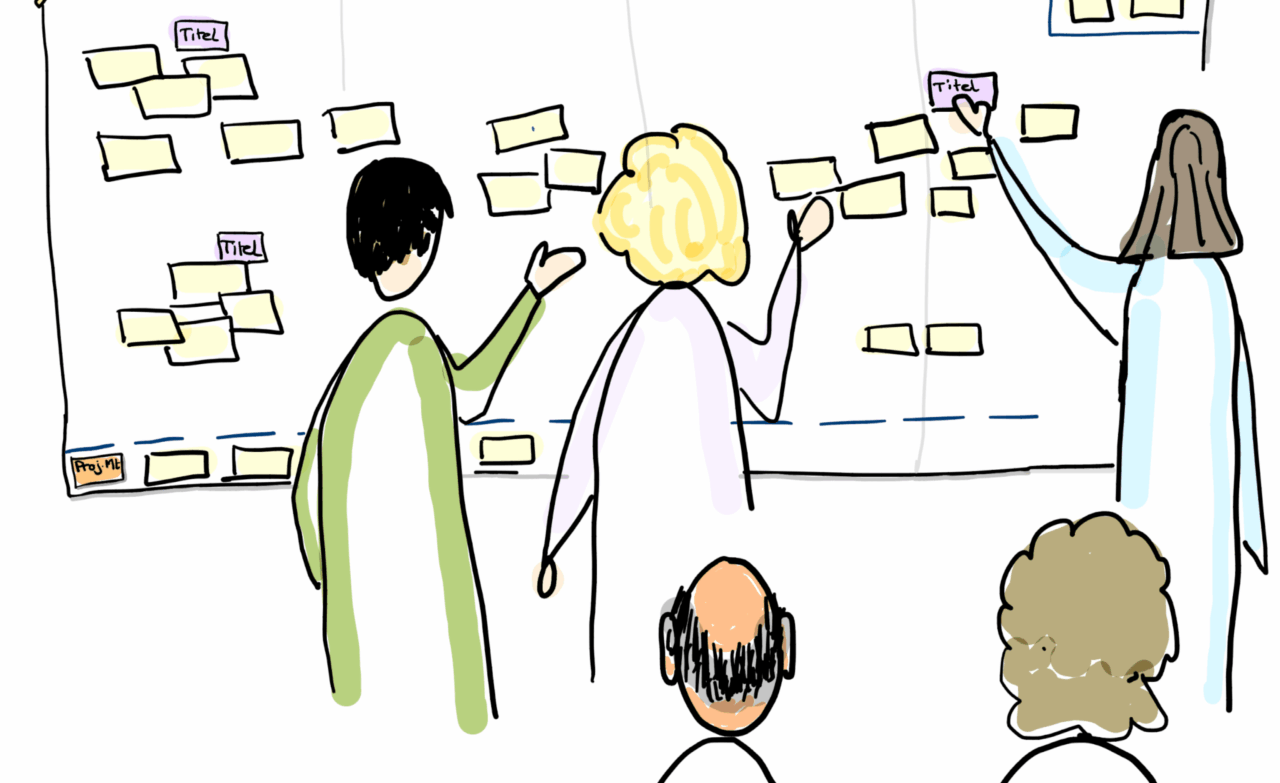
Preparing
A good intake with the project manager is the basis. Use Preparing a Project Startup for this: a checklist for the intake and a template for your meeting design. Sample agendas can be found under Project Startup.
The start of the meeting
Well begun is half done. Take time on the day itself to prepare the meeting; we are always there at least an hour in advance.
- The room. Make sure there is enough room to move, to work in different set-ups and in small groups, and enough light and air. Do you need tables? Are there enough walls for the flip charts? We almost always work with a circle of chairs without tables, so people can see each other well and there are no laptops in between.
- Welcome. Write "Welcome!" on the front flip chart, possibly with a drawing. Always keep a few blank sheets free. Pleasant music when people come in helps them relax; you can also use music to mark the breaks.
- The first words. Let the project manager open the meeting and introduce you. That makes it clear to everyone that you are not the project manager.
- Your start. First ask whether there are practical matters the team wants to share, such as having to leave early. Then explain the programme and make clear that it is their agenda.
- Your role. Explain that you will not interfere with the content and that your role is mainly facilitating, comparable to an independent chair. For decisions about the project you look to the project manager. This is extra important if you are an internal facilitator whom people also know in another role.
- Getting acquainted. At least let everyone say what their motivation is for taking part. We often use scaling questions for this.
- The atmosphere. Let the team think about the atmosphere in which they want to work together, with the Team Spirit exercise.
When we facilitate ourselves, we often use scaling questions and Team Spirit one after the other, in that order.
Difficult situations
What you experience as resistance is usually a form of involvement. Someone who behaves in a difficult way has a good intention; it is up to you to discover it. So do not go against the resistance, but explore. You can do that with SHIFT:
- Stimulate the participant to speak up. "I see you are frowning, what does that frown mean?"
- Honour it when someone speaks up. "Good that you say this, now your concern is clear."
- Identify the possible solutions, possibly in a conversation during the break. Usually people know best themselves what they need to get on board.
- Facilitate the steps to realise that solution, within your responsibility as facilitator.
- Test whether this is enough to continue. A new objection may still come up.
At the start, also agree on how the team wants to deal with differences of opinion, and agree that what is discussed stays in the room and that there are no stupid questions.
Tools for project meetings
- ExerciseAssignment workshop Explanation and agenda for the assignment workshop pdf (opens in a new tab)
- ExerciseCollective intake Exercise: collective intake pdf (opens in a new tab)
- ExerciseDiscussing commitment Exercise: discussing commitment pdf (opens in a new tab)
- ExerciseEvaluation Explanation for facilitators: evaluating with the lemniscate pdf (opens in a new tab)Exercise: project evaluation – the session in seven steps pdf (opens in a new tab)Article: Evaluating is looking ahead pdf, in Dutch (opens in a new tab)
- ExerciseForce field analysis Force field analysis instructions pdf (opens in a new tab)Force field analysis canvas pdf (opens in a new tab)
- TemplateLetter to the sponsor Letter to the sponsor pdf (opens in a new tab)
- TemplatePreparing a Project Startup Project Startup checklist pdf (opens in a new tab)Project meeting design template docx
- ExerciseProject Startup One-day Project Startup agenda pdf (opens in a new tab)Two-day Project Startup agenda pdf (opens in a new tab)
- ExerciseRisk analysis and risk management Risk analysis step-by-step plan pdf (opens in a new tab)
- ExerciseTeam Spirit Team Spirit: intention for collaboration pdf (opens in a new tab)
- ExerciseThe project fresh-up Exercise: project fresh-up pdf (opens in a new tab)
- ExerciseWorking with scaling questions Working with scaling questions pdf (opens in a new tab)
- ExerciseWorld café for a project with broad support Exercise: world café pdf (opens in a new tab)